


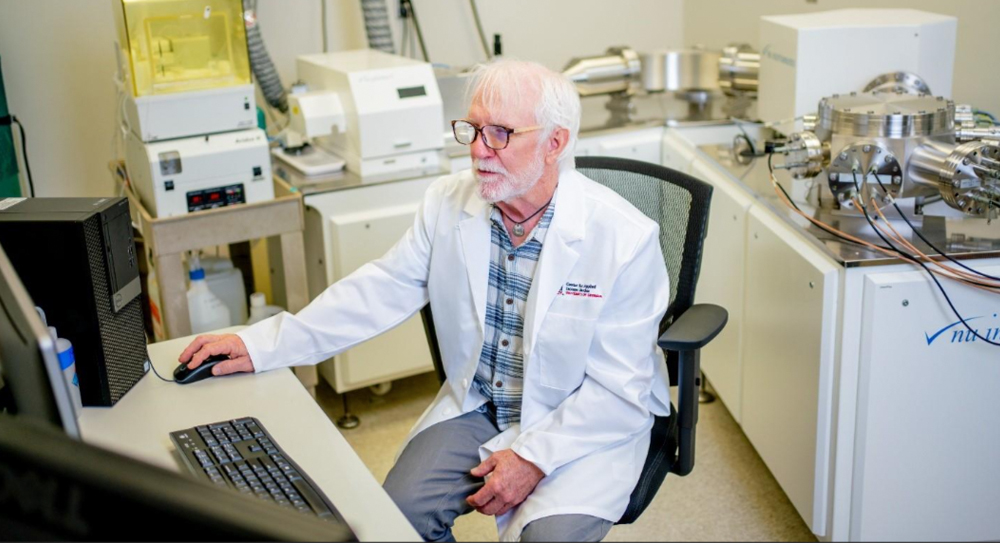
The Plasma Chemistry Laboratory at CAIS is an analytical laboratory specializing in the analysis of heavy metals, nutrients, major, minor and trace elements, as well as radiogenic isotopes in biological, environmental, geological, archaeological and other materials. This page is for our radiogenic isotopes services [for our elemental (metals) analysis services, please click here; for 14C analysis, please click here].
We only offer solution-based analyses and we prefer to do the sample preparation here.
Equipment: The radiogenic isotope laboratory is equipped with the following:
- nuPlasma II multicollector ICP-MS for the high precision analysis of radiogenic isotopes.
- Elemental Scientific (ESI) Apex Omega desolvating nebulizer for analysis of small samples.
- Wet chemistry lab with a digestion block, metal-free fume hood, and ultra-pure water for acid digestion of samples for MC-ICP-MS.
- Vacuum-assisted column chemistry chamber
More information on the equipment can be found on our Plasma Chem Lab facility page. We also have access to a class 100/1000 Cleanroom for processing sensitive samples, a muffle furnace for ashing, microbalances for samples under 20 mg, a lyophylizer for freeze drying, and a micromill for taking small sub-samples.
Strontium isotopic ratios are widely used as tracers in geological processes and as indicators of provenance in an archaeological context.
87Sr/86Sr Applications
Geology: A significant fraction of the Earth’s 87Sr is not primordial but is produced by the decay of 87Rb. Geochemically, strontium follows calcium, while rubidium follows potassium; thus, the geological variability of Sr isotope ratios in rocks is a function of both their age and chemical composition, particularly, their Ca/K ratios. Since these parameters can vary widely between different geological environments, and because different geological processes can fractionate rock chemistry in predictable ways, Sr isotopic ratios serve as tracers regarding the origins of igneous rocks.
Sr isotopic compositions of oilfield brines (produced waters) are often used in tracer studies by petroleum companies or environmental consultants. By comparing the 87Sr/86Sr of oil well-produced waters with those of the surrounding aquifers or surficial waters, one can track or monitor the degree of contamination between production waters and spatially associated agricultural, recreational, and drinking water.
Chemostratigraphy: Also of interest to earth scientists is the Sr isotopic composition of seawater, which has varied through geological time. In this case, variability is set up by the competing rates of sea-floor production, and weathering of continental landmasses. Marine organisms, such as foraminifera, that produce calcium carbonate from seawater will inherit the Sr isotopic composition of the global ocean at that point in time and this can be useful for dating sediment from the sea floor.
Archaeology: Archaeologists use the isotope ratios of strontium to determine residential origins and migration patterns of ancestral humans. The human body incorporates Sr by way of diet. Since Sr isotope ratios in soils, rocks, and waters vary widely in nature, and are not appreciatively fractionated by biologic processes, the assumption is that the isotope values for strontium in bone and tooth enamel will reflect those in the portion of the biosphere in which an individual lived. Thus, strontium isotope composition provides links to the land where food was grown or grazed.
87Sr/86Sr Analysis
Sample Preparation: We strongly prefer to do all sample pre-treatment and purification work in-house, as it is imperative to have control over reagent purity and other sources of contamination. If you have access to suitable preparation labs and wish to do some of this work outside of our facilities, please contact us to discuss protocols.
Depending on the needs of the researcher, we can digest materials completely, or we can leach readily available material via partial extraction. We then purify Sr by standard cation exchange methods using small-volume Eichrom Sr-specific resin columns, thus minimizing the volume of reagents used and minimizing the reagent contribution to blank levels. We use only high-purity reagents.
Analysis: Sr isotope measurements are done on a nuPlasma II mass spectrometer fitted with 16 faraday cups and 5 ion counters. 87Sr/86Sr ratios are corrected for mass bias, the presence of Rb, and for isobaric interference of Kr impurities in the Ar gas. We run NBS 987 during all sample runs as a reference check. We report 87Sr/86Sr ratios. We do not analyze 90Sr. For Sr concentrations, please see our elemental (metals) analysis services here.
Lead isotopic ratios (207Pb/206Pb, 208Pb/206Pb, 206Pb/204Pb, 207Pb/204Pb, 208Pb/204Pb) are used as tracers in geological processes and as indicators of provenance in an archaeological context.
Lead Ratio Applications
Geology: Lead is a common trace constituent found in all rocks. It occurs as the radiogenic daughter product of U and Th decay, but it also forms its own minerals where radiogenic Pb is not found, due to the exclusion of U and Th in the mineral. As a result, its isotopic ratios vary widely as a function of age and the ratio of U and Th. Aside from its use in geochronometry, this variability makes it a useful tracer in geologic, archaeological and forensic studies, as it records the chemical environment on which the Pb resided. Since these parameters can vary widely between different geological environments, and because various geological processes (including the generation and fractionation of magmas; hydrothermal and metamorphic processes; and surficial processes including weathering) can change U/Pb and U/Th ratios, Pb isotopic ratios serve as tracers regarding the origins of rocks.
Archaeology: Archaeologists use the isotope ratios of Pb much as they do those of Sr; in fact, the two systems are often used in conjunction with each other to determine residential origins and migration patterns of ancestral humans. As with Sr, the assumption is that the isotope ratios for Pb in bone and tooth enamel will reflect those in the portion of the biosphere in which an individual lived, thus providing information about the land where food was grown or grazed.
Lead isotopes can be used to determine the origins of metal and other artifacts.
Environment: Industrial Pb pollution (e.g., from leaded gasoline or mining) can be traced using lead isotopes.
Lead Ratio Analysis
Sample Preparation: We strongly prefer to do all sample pre-treatment and purification work in-house, as it is imperative to have control over reagent purity and cleanroom conditions. If you have access to suitable preparation labs and wish to do some of this work outside of our facilities, please contact us to discuss protocols.
Depending on the needs of the researcher, we can digest materials completely or we can leach readily available material via partial extraction. We then purify Pb by standard cation exchange methods using small-volume columns, thus reducing the volume of reagents used, and minimizing the reagent contribution to blank levels. We use only high-purity reagents and all work is done in a controlled cleanroom environment.
Analysis: Pb isotope measurements are done on a nuPlasma II mass spectrometer fitted with 16 faraday cups and 5 ion counters. We run NBS 981 during all sample runs as a reference check, using sample-standard bracketing to monitor instrument drift. We use 205Tl and 203Tl to correct for mass discrimination and to improve the stability of measured ratios within a sample run. We report the following ratios: 207Pb/206Pb, 208Pb/206Pb, 206Pb/204Pb, 207Pb/204Pb, 208Pb/204Pb. We do not analyze 210Pb. For Pb concentrations, please see our elemental (metals) analysis services here.
We accept the following sample types. Depending on the needs of the researcher, our lab can digest materials completely, or we can leach readily available material via partial extraction.
Bones and other mineralized tissue: For example, bones, teeth, otoliths, fins, foraminifera, shells, and other mineralized tissue. We can analyze both modern and archaeological samples.
Metals & Alloys
Plant material: For example, leaves, stems, roots, flowers, seeds, and other plant tissues. We prefer dry samples. Wet tissue is considered perishable and should be shipped accordingly.
Water: For example, river water, groundwater, oilfield brine (produced water). Please let us know if you expect contamination so we can tailor our methods accordingly.
Soil & sediment: Note: we do not have rock crushing, separation, or fusion capabilities.
Rocks and minerals: Note: we do not have rock crushing, separation, or fusion capabilities.
Other materials: We cannot accept infectious materials or controlled substances. Samples containing oil, fuel, or organic solvents must be disclosed.
For other materials not listed above, please contact us.
- If you are a first-time client (or a returning client requesting a different service) please Contact Us before sending your samples so we can help you choose the right analysis for your samples. If you are a returning client please give us a heads-up when you send samples.
- Label sample containers clearly with a unique identifier. Close container lids tightly and seal well with parafilm or tape to prevent them loosening in transit.
- Complete the Plasma Chemistry Laboratory Sample Submission Form, and include a printed copy with your samples. If you are sending more than 10 samples, please also e-mail us an electronic copy of the sample submission form or a sample inventory spreadsheet.
- Local clients may drop off samples with a completed sample submission form Monday – Friday (excluding UGA holidays) 8:30am – 4:30pm. UGA clients must note their speedtype or chartstrings on the form unless they are paying by another method. We do not accept UGA PCards.
- If shipping, package your samples in a crush-proof box or container. For liquids: do not use glass; seal the containers in a plastic bag with some paper towel or an absorbent pad in case of leaks (for fizzy liquids or solvents, please double-bag, with absorbent in the second bag as well). Package Perishable samples should be shipped frozen in an insulated box with dry ice.
- Address the package to:
Attn: Alex Heri
Plasma Chem Lab
Center for Applied Isotope Studies
120 Riverbend Rd.
Athens, GA 30602
USA
Shipping phone: 706-542-1395
Please DO NOT select any Saturday or weekend delivery options. For perishable samples, please try to time your shipment so the samples do not spend the weekend on a truck or in a warehouse (i.e., ship them on a Monday or Tuesday so they arrive on a Wednesday or Thursday).
Turnaround: Turnaround time is approximately 2 – 6 months, but it may take longer if we run into unanticipated issues.
Rates & Fees: Our current standard rates (as of July 1, 2025) are listed in the tables below. For training, demos, collaborations, or large/ongoing projects please contact us.
Quotes: If you require an estimate or formal quote, please let us know the sample type/matrix, number of samples, isotope system(s), sample preparation required, and your application/research question. Please reference this Quote No. on your submission form.
Purchase Orders: If you plan to use a purchase order (PO) and you work at a university or large company you will most likely need a formal quote before you can request a PO, which should be done before submitting samples. Please reference the PO No. on your submission form and send a copy of your PO to icpms@uga.edu or include it with your submission form.
Payments: Please see the CAIS FAQ.
New clients: Please Contact Us prior to submitting samples.
| Analysis, per sample | |
|---|---|
| Sr isotopes (87Sr/86Sr), extraction and analysis (MC-ICP-MS) | $200 |
| Pb isotopes (207Pb/206Pb, 208Pb/206Pb, 206Pb/204Pb, 207Pb/204Pb, 208Pb/204Pb), extraction and analysis (MC-ICP-MS) | $200 |
| Sr concentrations (ppm=mg/kg), extraction and analysis (ICP-OES) | $60.50 |
| Pb concentrations (ppb=µg/kg), extraction and analysis (ICP-MS) | $66 |
| Other | |
|---|---|
| Minimum charge per invoice | $250 |
| USG & Emory discount | -20 % |
| UGA discount (contact us for small sample sets or Rush service) | -20 %; no min. |
| Indigenous peoples discount | See CAIS FAQ |
| Sample return | See CAIS FAQ |
Please let us know the sample type/matrix, isotope system(s), sample preparation required, and your application/research question so we can advise you.
Assistant Research Scientist
Co-PI of Plasma Chem Lab (radiogenic isotopes)
Office 157: 706-542-6136