


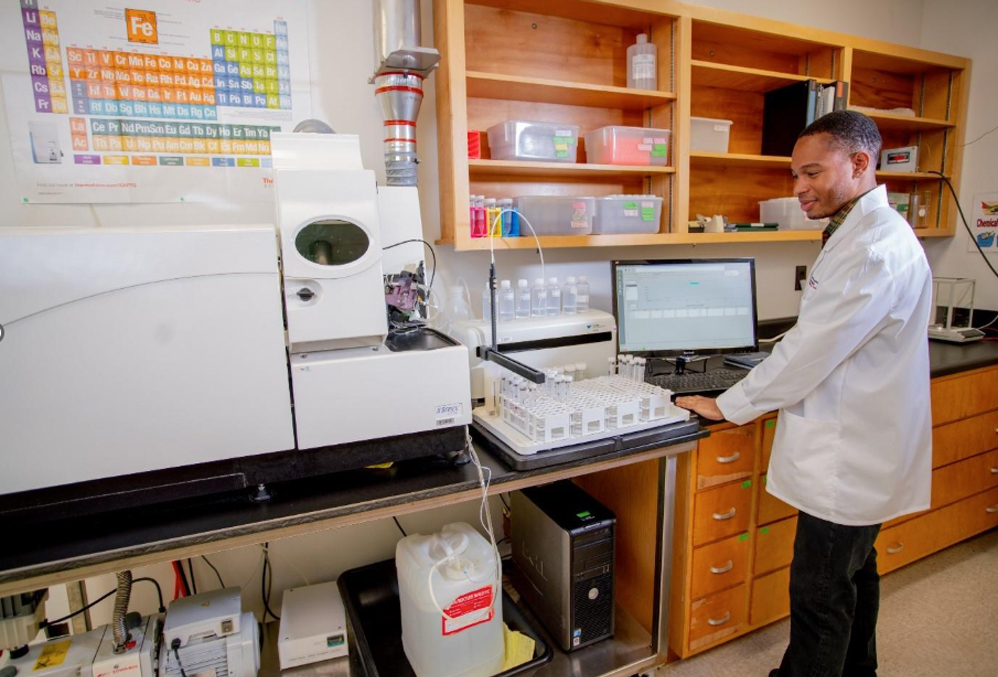
The Plasma Chemistry Laboratory at CAIS is an analytical laboratory specializing in the analysis of heavy metals, nutrients, major, minor and trace elements, as well as radiogenic isotopes in biological, environmental, geological, archaeological and other materials. This page is for our elemental (metals) analysis services [for our radiogenic isotopes services, please click here].
Equipment: The elemental laboratory is equipped with the following:
- Perkin Elmer 8300 ICP-OES for analysis of nutrients and major elements.
- Thermo X-Series II ICP-MS for analysis of heavy metals, minor, and trace elements.
- Milestone DMA-80 for direct analysis of mercury in solids or liquids.
- Wet chemistry lab with a digestion block, metal-free fume hood, and ultra-pure water for acid digestion of samples for ICP-OES and ICP-MS.
- Coming soon: laser ablation for direct and spatial analysis of solids by ICP-MS without acid digestion.
More information on the equipment can be found on our Plasma Chem Lab facility page. We also have access to a class 100/1000 Cleanroom for processing sensitive samples, a muffle furnace for ashing, microbalances for samples under 20 mg, a lyophylizer for freeze drying, and a micromill for taking small sub-samples.
Sample Preparation: Samples for ICP-OES and ICP-MS must be in solution (acidified for clean water or acid-digested for everything else) prior to analysis. You may digest the samples yourself and submit diluted digest solutions (2 – 5 % w/w HNO3, HCl, or aqua regia). Alternatively, we can do the digestions here. Please see Sample Types We Analyze below for more information on the requirements for various samples types. Please note that we do not use HF in our digestion procedures so for soils and other silicates we offer a leach analysis rather than a total digestion.
Liquid samples for Hg analysis by DMA require no sample preparation. Solid samples may require gentle drying or possibly grinding prior to DMA analysis, but no digestion is required.
Analysis: Depending on the element(s) and approximate concentrations, we run samples by DMA, ICP-OES, and/or ICP-MS. See Elements We Analyze below for a list of elements we can run on each instrument. We report element (metal) concentrations as mass fractions (by dry weight, except for cells and liquid samples):
- ppm (mg/kg or µg/g): mg metal / kg of sample or µg metal / g of sample
- ppb (µg/kg): µg metal / kg of sample.
For further information, please expand the sections below or contact us.
We accept the sample types listed below (please expand for more information).
We do not use hydrofluoric acid (HF) in our digestion procedures and therefore silicates and other refractory materials may not fully dissolve. We therefore do not offer analysis of Si, Sn, Sb, Ti, or other metals that require HF to remain stable in solution, except for water (total recoverable). We cannot accept samples containing hydrofluoric acid (HF), so if you are digesting your own samples with HF, be sure to evaporate any HF before redissolving in nitric or hydrochloric acid.
Please also see How Much Sample to Send below. For further information (digestion procedures, choice of acid, ICP-OES vs. ICP-MS, etc.), please see our Resources section on the right side of this page or contact us.
Proteins
Proteins are acid-digested (concentrated acid and heating) before analysis by ICP-MS (or ICP-OES for high concentration protein samples or high metal binding stoichiometry). You may digest the samples yourself and submit diluted digest solutions: maximum 2 – 5 % (w/w) HNO3 (preferred), aqua regia, or HCl. Alternatively, we offer digestion services. Please let us know of any buffers or additives in your samples so we can tailor our methods.
To determine what volume of protein solution to send, please let us know which metal(s) you want to measure, the protein concentration (M) and the expected binding stoichiometry (moles of metal per mole of protein) for each metal. The volume required will depend on these factors, as well as the limit of detection for each metal.
We cannot accept samples containing urea.
You may also be interested in organic compound characterization and quantification (LEA organic) and compound-specific stable isotope services at CAIS.
Cells
Cell pellets are acid-digested and analyzed by solution-based ICP-MS (or ICP-OES for high-uptake metals or large cell pellets). The entire contents of the tube will be digested, so cells must be washed to ensure none of the metal-containing media or drug treatment is present. We report metal concentrations in ppm (µg metal / g of cells, wet weight) or ppb (µg metal / kg of cells, wet weight) so accurate pellet masses are critical. Pellet masses must be provided on the sample submission form. If you are not able to provide accurate pellet masses, please Contact Us.
Please also provide an empty tube for use as a tube blank. We request ~100 mg of cells, but this can vary depending on the metals of interest (specifically their limits of detection and their expected uptake in your cells). Please contact us if you have small samples and/or want to analyze metals that are not easily taken up by your cells. Note that the 100 mg guideline is for cells that have been pelleted and had the liquid aspirated off. Freeze-drying will result in lower masses for the same number of cells but is also acceptable.
We do not accept infectious materials. You are responsible for sterilizing infectious material before shipping in a way that will not compromise the analysis.
Plant material
Leaves, stems, roots, flowers, seeds, and other plant tissues are lyophilized (freeze-dried) or oven-dried, ground, acid-digested, and analyzed by solution-based ICP-MS and/or ICP-OES. Plant cell walls and woody tissue require modified procedures.
You may digest the samples yourself and submit diluted digest solutions: maximum 2 – 5 % (w/w) HNO3 (preferred), aqua regia, or HCl. Alternatively, we offer digestion services for dried and powdered samples. Please contact us if you require drying or grinding. If you plan to grind your own samples, please choose the grinding material with care to avoid contaminating your samples.
We typically use dry tissue weights for the concentration calculations, but can use wet tissue weights upon request.
You may also be interested in residue analysis, radiocarbon, radiogenic isotope (Sr, Pb), C & N elemental analysis, and stable isotope services at CAIS.
Animal soft tissue
Organs and other soft tissues are lyophilized (freeze-dried), acid-digested, and analyzed by solution-based ICP-MS and/or ICP-OES. You may digest the samples yourself and submit diluted digest solutions: maximum 2 – 5 % (w/w) HNO3 (preferred), aqua regia, or HCl. Alternatively, we provide freeze-drying and digestion services for these samples. Please contact us if you require digestion, so we can tailor methods to your project.
We typically use dry tissue weights for the concentration calculations, but can use wet tissue weights upon request.
We do not accept infectious materials. You are responsible for sterilizing infectious material before shipping in a way that will not compromise the analysis. For further information (digestion procedures, choice of acid, ICP-OES vs. ICP-MS, etc.), please see our Resources section below or contact us.
You may also be interested in residue analysis, radiocarbon, C & N elemental analysis, and stable isotope services at CAIS.
Bones and other mineralized tissue
Bones, teeth, otoliths, fins, and shells, and other mineralized tissue are sub-sampled, washed, dried, acid-digested and analyzed by solution-based ICP-MS and/or ICP-OES. You may digest the samples yourself and submit diluted digest solutions: maximum 2 – 5 % (w/w) HNO3 (preferred), aqua regia, or HCl. Alternatively, we offer washing, drying, and digestion services. Please contact us if you require these, so we can tailor methods to your project. If you plan to grind your samples, please choose the grinding material with care to avoid contaminating your samples.
We do not accept infectious materials. You are responsible for sterilizing infectious tissue before shipping.
You may also be interested in radiocarbon, radiogenic isotope (Sr, Pb), and stable isotope services at CAIS.
Water
We offer two types of water analysis, modified from EPA 3005a:
Total Dissolved Metals: water is filtered immediately after collection, then the filtrate is acidified.
Total Recoverable Metals: water is not filtered; a representative subsample is acid-digested.
Acidified or digested water is analyzed by solution-based ICP-MS and/or ICP-OES. For ICP-MS, further dilution may be necessary for high salinity (>200 ppm or 9 mM). Please note that we cannot accept brine or seawater for ICP-MS—the amount of dilution required would bring trace elements below the limits of detection.
You may also be interested in radiogenic isotope (Sr, Pb), C & N elemental analysis, ions, and stable isotope services at CAIS.
Soil & sediment
Soils and sediments are dried, powdered, acid-digested or leached, and analyzed by solution-based ICP-MS and/or ICP-OES.
If you plan to grind your own samples, please choose the grinding material with care to avoid contaminating your samples. You may digest the samples yourself and submit diluted digest solutions: maximum 2 – 5 % (w/w) HNO3 (preferred), aqua regia, or HCl. Alternatively, we can do the digestions here for dried and powdered samples. Please contact us if you require drying or grinding.
We do not use hydrofluoric acid (HF) in our digestion procedures and therefore silicates and other refractory materials may not fully dissolve. We therefore offer a leach analysis rather than a total digestion and do not offer analysis of Si, Sn, Sb, Ti, or other metals that require HF to remain stable in solution. This may be suitable for your application if you are interested in bioavailable elements.
We do not have rock crushing, separation, or fusion capabilities. We do not accept metals, alloys, ores, refractory minerals, glasses, whole rocks, or fusions. We cannot accept samples containing hydrofluoric acid (HF), so if you are digesting your own samples with HF, be sure to evaporate any HF before redissolving in nitric or hydrochloric acid.
You may also be interested in radiogenic isotope (Sr, Pb), C & N elemental analysis, stable isotope services, metal speciation, and soil testing at CAIS.
Nanomaterials
Nanomaterials are acid-digested and analyzed by solution-based ICP-MS and/or ICP-OES. The digestion protocol will depend on nanomaterial composition. Tissue containing nanomaterials is digested using an animal soft tissue protocol (see above), modified depending on nanomaterial composition. You may digest the samples yourself and submit diluted digest solutions: maximum 2 – 5 % (w/w) HNO3 (preferred), aqua regia, or HCl. Alternatively, we can do the digestions here. Please contact us so we can tailor methods to your project.
We do not perform single particle analysis of nanoparticles.
Medical devices
Leaching solutions in contact with medical devices are acid-digested and analyzed by solution-based ICP-MS and/or ICP-OES. You may digest the samples yourself and submit diluted digest solutions (2 – 5 % w/w HNO3, HCl, or aqua regia). Alternatively, we can do the digestions here. Please contact us so we can tailor methods to your project.
We do not analyze metal components directly.
Drugs & other organic compounds
Drugs and other organic compounds can be measured for metals upon request. Sample preparation methods will be tailored to the type and state of your compounds. Please contact us to discuss options. We do not have a DEA license so samples of controlled substances will need to be irreversibly decomposed (e.g., by acid digestion) prior to shipping.
You may also be interested in organic compound characterization and quantification and compound-specific stable isotope services at CAIS.
Food & beverage
Depending on the type of food, beverage, additive, or ingredient, samples may be analyzed using protocols similar to water, plants, drugs, or animal tissue listed above. You may digest the samples yourself and submit diluted digest solutions (2 – 5 % w/w HNO3, HCl, or aqua regia). Alternatively, we offer digestion service. Please contact us so we can tailor methods to your project.
We do not accept infectious materials (e.g., salmonella). You are responsible for sterilizing infectious material before shipping in a way that will not compromise the analysis. We do not accept essential oils, perfumes, salt, or brines. Please contact us in advance if you plan to send fragrant materials.
You may also be interested in authenticity testing and gamma testing services at CAIS.
Other materials
We do not accept metals, alloys, ores, refractory minerals, glasses, whole rocks, fusions, essential oils, fuels, perfumes, salt, brines, or seawater. We cannot accept infectious materials or controlled substances. We cannot accept samples containing hydrofluoric acid (HF) or urea. Samples containing organic solvents must be disclosed.
For other materials not listed above, please contact us.
- If you are a first-time client (or a returning client requesting a different service) please Contact Us before sending your samples so we can help you choose the right analysis for your samples. If you are a returning client, please give us a heads-up when you send samples.
- If you plan to do the digestions yourself please refer to our Sample Preparation Guide for Metals Analysis for information on preparing the samples or contact us for tips.
- Label sample containers clearly with a unique identifier. Close container lids tightly and seal well with parafilm or tape to prevent them loosening in transit. For liquids or wet solids: do not use glass containers.
- Complete the Plasma Chemistry Laboratory Sample Submission Form, and include a printed copy with your samples. If you are sending more than 10 samples, please also e-mail us an electronic copy of the sample submission form or a sample inventory spreadsheet. For cell pellets please record the sample weights on the sample submission form.
- Local clients may drop off samples with a completed sample submission form Monday – Friday (excluding UGA holidays) 8:30am – 4:30pm. UGA clients must note their speedtype or chartstrings on the form unless they are paying by another method. We do not accept UGA PCards.
- If shipping, package your samples in a crush-proof box or container. For liquids: seal the containers in a plastic bag with some paper towel or an absorbent pad in case of leaks (for fizzy liquids or solvents, please double-bag, with absorbent in the second bag as well). Perishable samples should be shipped frozen in an insulated box with dry ice.
Address the package to:
Attn: Sarah Jantzi
Plasma Chem Lab
Center for Applied Isotope Studies
120 Riverbend Rd.
Athens, GA 30602
USA
Shipping phone: 706-542-1395
Please DO NOT select any Saturday or weekend delivery options. For perishable samples, please try to time your shipment so the samples do not spend the weekend on a truck or in a warehouse (i.e., ship them on a Monday or Tuesday so they arrive on a Wednesday or Thursday).
Turnaround: Standard turnaround time is 4 – 8 weeks, but it may take longer if we run into unanticipated issues.
Rates & Fees: Our current standard rates (as of July 1, 2025) are listed in the tables below. For training, demos, collaborations, or large/ongoing projects please contact us.
Quotes: If you require an estimate or formal quote, please let us know the sample type/matrix, number of samples, type of analysis and sample preparation required, and what elements you need measured. Please reference this Quote No. on your submission form.
Purchase Orders: If you plan to use a purchase order (PO) and you work at a university or large company you will most likely need a formal quote before you can request a PO, which should be done before submitting samples. Please reference the PO No. on your submission form and send a copy of your PO to icpms@uga.edu or include it with your submission form.
Payments: Please see the CAIS FAQ.
New clients: Please Contact Us prior to submitting samples.
Sample Processing, per sample
Pre-processing, solids (washing, drying, milling, etc) $2
Pre-processing, liquids (evaporation, dilution, acidification, etc.) $2
Water, Total Dissolved $5
Water, Total Recoverable $25
Digestion/leach (includes dilution) $27.50
Elemental Analysis, per sample
ICP-OES, 1 element
$33
ICP-MS, 1 element $38.50
Additional element, standard, per element per sample $1.50
Additional element, non-standard, per element per sample $6.50
DMA, Total Hg, along with ICP $20
DMA, Total Hg only $40
Other
Minimum charge per invoice $250
USG & Emory discount -20 %
UGA discount (contact us for small sample sets or Rush service) -20 %; no min.
Indigenous peoples discount See CAIS FAQ
Sample return See CAIS FAQ
Both ICP-MS and ICP-OES are used to determine the concentrations of multiple elements. For most elements either instrument may be used, so how do you know which is best for your samples? Considerations include detection limits, concentration, interferences, and cost. ICP-MS can identify concentrations in the sub-ppb to ppb range, while ICP-OES is ideal for the ppm range. ICP-MS is typically more expensive than ICP-OES. Some elements have interferences on one instrument that make analysis difficult, but little to no interference on the other instrument.
A literature search can help you identify how previous researchers have analyzed similar samples and how to best deal with the shortcomings of each analytical method. You are welcome to contact us to discuss your options. Check out our Theory page for further information on the two instruments and how they work.
Please expand the titles below for a list of elements we analyze on each instrument.
* Not available for solid samples; please inquire
**ICP-MS for trace levels only
DMA
- Hg
ICP-OES (for nutrients and major/matrix elements)
- Standard Elements: Li, Be, B, Na, Mg, Al, Si*, P, K, Ca, Ti*, V, Cr, Mn, Fe, Co, Ni, Cu, Zn, As, Se, Sr, Mo, Ag, Cd, Sn*, Ba, Ce, Tl, Pb.
- Non-standard Elements: S, Sc, Ga, Ge*, Rb, Y, Ru, Rh, Pd, Sb*, Te, Cs, La, Pr, Nd, Sm, Eu, Gd, Tb, Dy, Ho, Er, Tm, Yb, Lu, Re, Ir, Pt, Au, Bi, Th, U.
ICP-MS (for heavy metals and trace elements)
- Standard Elements: Li, Be, Na**, Mg, Al, K**, V, Cr, Mn, Fe, Co, Ni, Cu, Zn, Ga, As, Se, Rb, Sr, Ag, Cd, Cs, Ba, Tl, Pb, U.
- Non-standard Elements: Sc, Ti*, Ge*, Y, Mo, Ru, Rh, Pd, Sn*, Sb*, Te, La, Ce, Pr, Nd, Sm, Eu, Gd, Tb, Dy, Ho, Er, Tm, Yb, Lu, Re, Ir, Pt, Au, Bi, Th.
Material Minimum Ideal
DMA, solidsb 50 mg 250 mg
DMA, liquids 0.25 mL 1 mL
Soil or plant, tracea,b 200 mg 500 mg
Soil or plant, majora,b 30 mg 100 mg
Animal tissue, traceb 100 mg 500 mg
Animal tissue, majorb 30 mg 200 mg
Bones & teeth 200 mg 2000 mg
Cell pelletsc 30 mg 100 mg
Protein, for digestd inquire inquire
Protein, digestedd inquire inquire
Organic solidsb 30 mg 500 mg
Organic liquids 0.03 mL 1 mL
Water 3 mL 15 mL
Associate Research Scientist
Co-PI of Plasma Chem Lab (elemental & metals)
icpms@uga.edu for sample analysis queries
sarah.jantzi@uga.edu for research and other queries
Office 158: 706–542–4338