


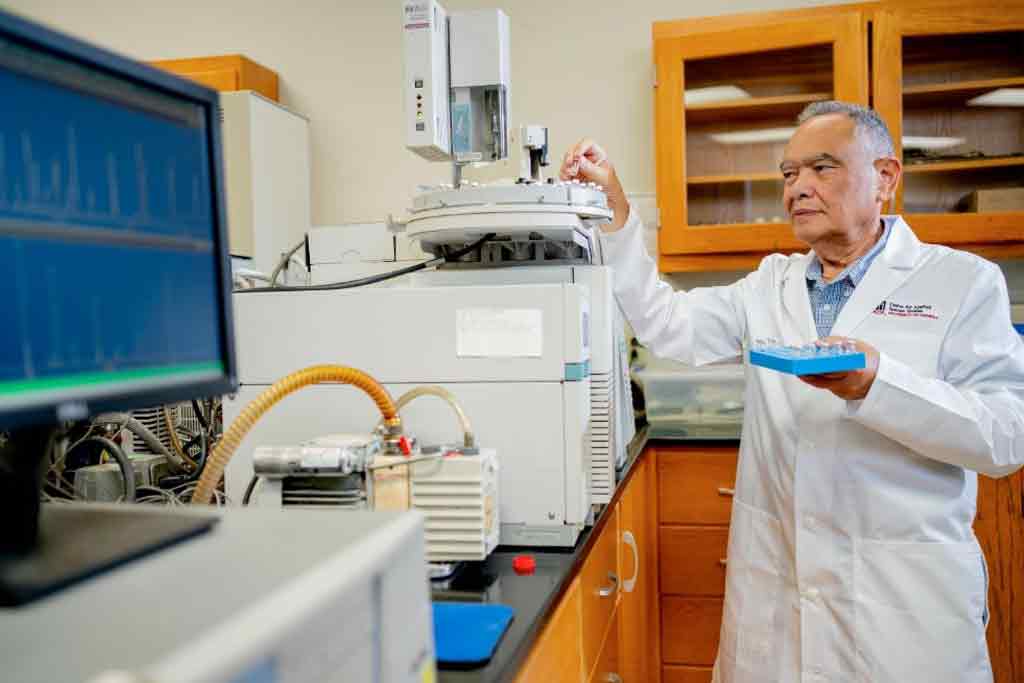
The Center for Applied Isotope Studies Laboratory for Environmental Analysis (LEA) provides high quality analyses of organic or inorganic environmental samples and contaminants, ions and ion speciation. We also provide a variety of soil characterization and analyses to university and industry researchers.
Ion Chromatography
Ion chromatography is a separation technology that uses an anion exchange column to separate anions moving through the column, which are then measured by a detector system at the column outlet.
Ion chromatography is performed using a DIONEX DX500 modular chromatography system with conductivity, electrochemical and absorbance detectors. Common anions are separated using a IonPac AS4A column and detected by suppressed conductivity. The SRS -II self-regenerating suppressor (DX500 system) enhances analyte sensitivity by providing superior suppression of the background carbonate eluent conductivity resulting in significant improvement in analyte detection limits.
Ionic Speciation
Specific ionic species in solution can be determined using ion chromatography as a separation technique, for instance, Fe(II) and Fe(III) in waters or extracts can be determined by ion chromatography with separation on IonPac CS5A column and absorbance detection following post column derivatization. Specific measurement of Cr (VI) can be made using an IonPac AS7 column with detection by UV/vis following postcolumn derivatization.
For other elements e.g., arsenic and selenium, methods can be devised for separation of differing valence states on the IC, and eluent from the IC injected into the ICP-MS for detection at sub-ppb levels. Additionally, methods exist for determination of methylated forms of arsenic and mercury based on column retention and either IPC-MS or cold-vapor absorption detection See Metals Analysis page for more details.
Other Ion Analyses
Other dissolved ions are often determined potentiometrically; H+ (i.e., pH), and electrical conductivity (EC) are common potentiometric methods, described in the Other Services page. Other elements, particularly the halogens (chlorine, bromine), can be determined using ion-specific electrodes and may be a good analytical choice for large numbers of samples at higher (ppm+) levels requiring only a single element analysis.