


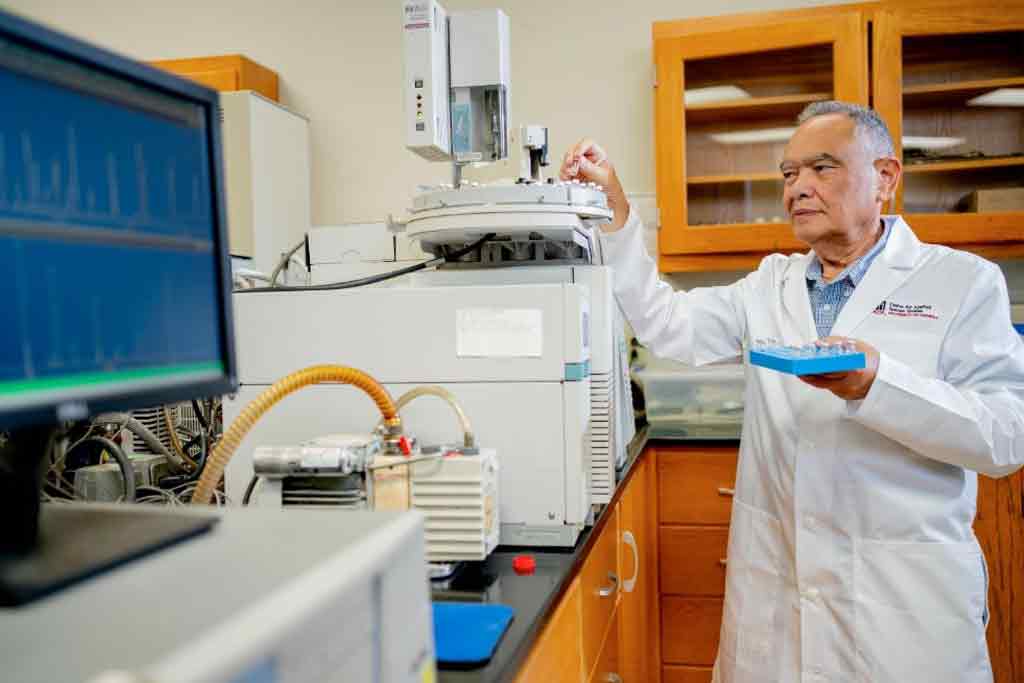
The Center for Applied Isotope Studies Laboratory for Environmental Analysis (LEA) provides high quality analyses of organic or inorganic environmental samples and contaminants, ions and ion speciation. We also provide a variety of soil characterization and analyses to university and industry researchers.
Organic Compounds and Contaminants
There are tens of thousands of potentially toxic organic compounds in soils, waters, and waste products, which makes organic compound analysis much more challenging than for the limited number of inorganic (elemental) analytes. Organics are often regulated by EPA at ppb (parts per billion) levels and often occur in complex mixtures in contaminated samples that further complicate identification and quantification. Classes of organic compounds of environmental interest include aliphatic and aromatic petroleum hydrocarbons, industrial solvents, pesticides, and high-molecular weight compounds such as PCB’s, dioxins, etc.
Sample preparation for organic analysis varies with the sample type and compound(s) of interest and the matrix. For many compounds, samples are typically prepared by extracting the soil, sediment, or water sample with an organic solvent such as dichloromethane, acetone or hexane; this solvent phase is then “cleaned up” by extraction into another organic solvent to remove interfering compounds. The extracted analytes are subjected to quantitation using GC or HPLC procedure. The following is a partial list of compounds that may be routinely determined in water, feed, soil or plant or animal tissues:
- Pesticides: aldrin, chlordane, DDD, DDE, DDT, dieldrin, endrin, ethion, heptachlor, lindane, malathion, methoxychlor, methyl parathion, mirex, parathion, rabon, toxaphen.
- Glyphosate and its degradation product aminoethylphosphonic acid (AMPA)
- Volatile Organics: vinly chloride, 1,1-dichlorethylene, methylene chloride, 1,1-dichloroethane, chloroform, 1,1,1-trichloroethane, carbon tetrachloride, 1,1,2,2-tetrachloroethane, 1,2-dichloropropane, 1,1,2,2-tetrachloroethane, dibromochloromethane, chlorobenzene, bromoform, 1,2-dichlorobenzene
- Petroleum Products: n-decane, n-unedecane, n-dodecane, n-tridecane, n-tetradecane, n-pentadecane, n-hexadecane, n-heptadecane, n-octadecane, n-nonadecane, n-eicosane, n-henicosane, n-docasane, n-triosane, n-tetracosane, n-pentacosane, n-hexacosane, n-heptacosane, n-octacosane, n-nonacosane, n-tricontane, n-hentricontane, n-dotriacontane, n-tritriacontane, n-tetratricontane, n-penatriacontane, naphthalene, flourene, dibenzothiophene, phenanthrene, fluoranthene, pyrene, chrysene, benzo(b)fluoranthene, benzo(b)pyrene, perylene, indeno(1,2,3 cd)pyrene, dibenzo(a,h)anthracene, pristane, phytane, anthracene
- BTEX Compounds: benzene, toluene, ethylbenzene, o,m,p-xylenes.
- Sex Hormones: estradiol, estrone, estriol, testosterone
- Sterols: cholesterol, Coprastanol, epicoprastanol, chlestanol, campesterol, stigmasterol, sitosterol
- HP 6890 GC oven supplied with a HP 5973 mass selective detector (MSD) besides a thermal conductivity (TCD) and flame ionization (FID) detectors.
- HP 5890 Series II GC oven supplied with a HP 5971 MSD besides an electron capture detector (ECD) and purge and trap sample introduction that consists of Teckmar 2016 auto sampler and Teckmar 3000 concentrator.
- Varian GC/MS/MS consists of a CP-3800 oven, CP-8400 Autosampler, CP-8410 Autoinjector and 4000 Ion Trap Mass Spectrometer. The unit runs both electronic and chemical ionization under Varian MS workstation version 6.9 SP1.
- Shimadzu Liquid Chromatograph Mass Spectrometer model LC-MS-8080 equipped with column oven CTO-20A, degasser, DGU-20A, dual pump system LC-20AD and UV/Vis detector model SPD-20A.
- Shimadzu LC-10AS
- Shimadzu gradient system consists of 2 LC-600 pumps
- Each unit is equipped with a SPD-6AV UV-Vis detector, RF-535 Fluorescence monitor, SIL-9A Auto-injector and integrator for data processing.
- Stand Alone Spectrophotometers
- Shimadzu UV-Vis Recorder model UV-2501PC
- Spectronic Model 21D