
Generic selectors
Exact matches only
Search in title
Search in content
Post Type Selectors

Archaeological samples, objects of art, antiquities, and paleoenvironmental samples are cleaned and prepared for analysis in our modern and well-equipped Pretreatment Lab.

We recognize that each sample that comes through our lab is truly unique. We develop a custom pretreatment plans for each sample, taking into consideration the type of material, the age and amount of material available, as well as the object’s unique depositional history.

We offer many specialty services, including compound-specific analyses and micro-sampling. We are experts in the extraction and purification of bone collagen, as well as bone bioapatite and tooth enamel.

After pretreatment, samples are ready for combustion (organics) or acid hydrolysis (inorganics), which produces CO2 for graphitization.

CO2 samples are converted to graphite in the presence of Fe catalyst according to the hydrogen reduction reaction:

CO2 + 2H2 → C + 2H2O

Our Graphitization Lab is equipped with two custom-built, stainless steel graphitization lines, with a total of 24 reaction modules. Each reaction module is outfitted with its own oven, temperature control, and pressure transducer, to allow precise monitoring and control over each individual sample. This level of control makes it possible to handle ultra-small samples.
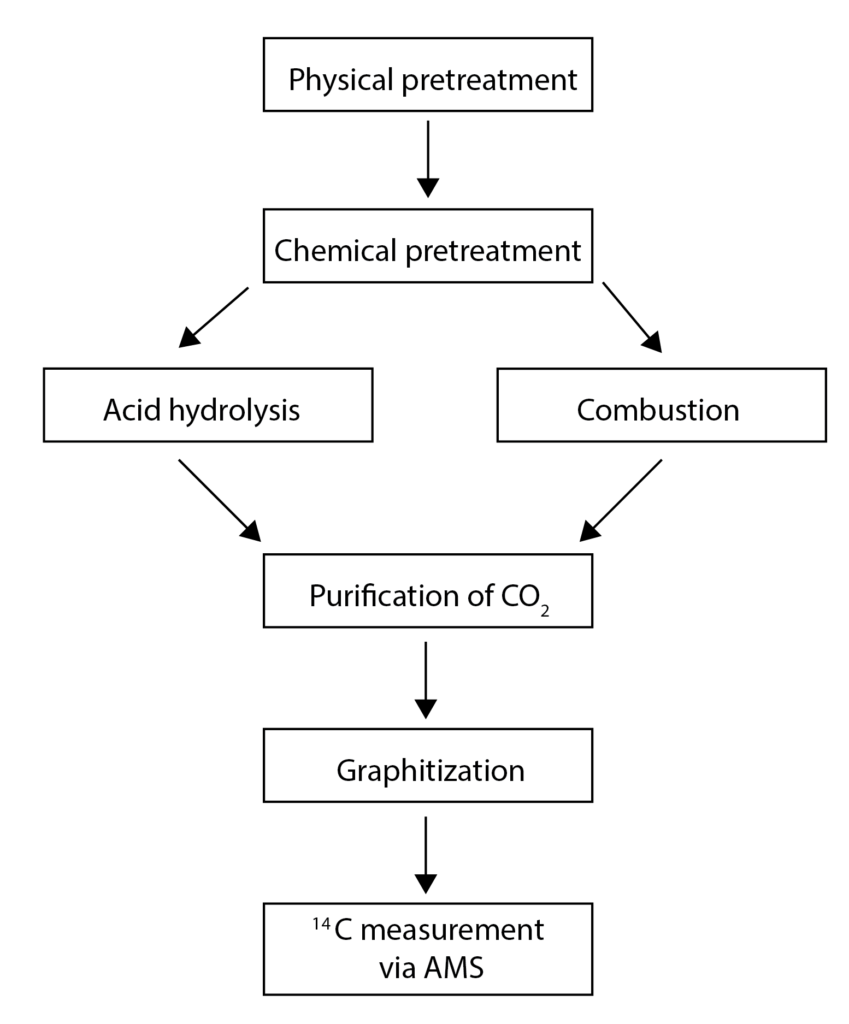
Flowchart showing steps for radiocarbon analysis at the facility: physical and chemical pretreatment, acid hydrolysis or combustion, CO₂ purification, graphitization, and ¹⁴C measurement via AMS.

Analytical Fees Chart

AMS Radiocarbon Dating

Standard (3 weeks)

Rush (7 days)

14C age by AMS

δ13C by IRMS

δ15N by IRMS

C:N ratio

δ18O by IRMS

δ34S by IRMS

Standard samples

charcoal, wood, seeds

$450

$800

included

included

by request no charge

organic-rich sediment

$450

$800

included

included

by request no charge

organic-poor sediment

$450

$800

included

included

by request no charge

paper, canvas, textile

$450

$800

included

included

by request no charge

carbonates (shell, forminifera, coral)

$450

$800

included

included

soil carbonates

$450

$800

included

included

water DIC

$450

$800

included

included

Bone and tooth samples

collagen (extraction included)

$500

$900

included

included

included

included

$20

bioapatite/enamel

$500

$900

included

included

included

collagen and bioapatite combo

$500

$900

included

included

included

included

included

$20

charred bone/tooth

$500

$900

included

included

cremated or calcined bone/tooth

$500

$900

included

included

included

Prepared samples

Combustion-ready samples

$400

$600

included

included

CO2 gas

$300

$450

included

included

Graphite (10 day turnaround)

$120

included

Sample Size Requirements

AMS Radiocarbon Dating

Minimum, mg

Optimum

Standard samples

charcoal, wood, seeds

.2

2-5 mg

organic-rich sediment

10

100 mg

organic-poor sediment

100

1-2 g

paper, canvas, textile

1

5-10 mg

carbonates (shell, forminifera, coral)

1-2

15-30 mg

soil carbonates

20-30

50-100 mg

water DIC

100 mL

1 L

Bone and tooth samples

collagen (extraction included)

100

1-2 g

bioapatite/enamel

100

1-2 g

collagen and bioapatite combo

200

2-3 g

charred bone/tooth

100

.5-1 g

cremated or calcined bone/tooth

200

.5-1 g

Prepared samples

Combustion-ready samples

please inquire

CO2 gas

please inquire

Graphite (10 day turnaround)

please inquire

Background and history of radiocarbon dating

In 1946 American chemist Willard Libby predicted that there should be a significant difference in 14C activity between living organisms and fossil carbons due to the long half-life of 14C. In the following years, Libby and his team of researchers at the University of Chicago conducted a series of experiments testing this prediction and its implications. This research ultimately led to the publication of the first set of radiocarbon dates in 1949.

One of the greatest achievements of Libby and his team was that they devised a means of measuring the extremely low concentrations of 14C that are found in nature. Instead of counting 14C atoms directly, they used a Geiger-Müller counter to measure the radioactivity of solid carbon samples, inferring the concentration of 14C from the number of decay events over time, in counts per minute (cpm). Libby and his team measured the 14C activity of modern terrestrial organisms, and concluded that the concentration of 14C in living things was constant across time and space. Thus, it would be possible to calculate the 14C activity expected at a given time after the organic material was removed from the life cycle.

Libby and colleagues tested their method on known-age geological and archaeological materials. The first reported radiocarbon age was for a piece of wood taken from the tomb of Zoser, an Egyptian king who reigned from 2665 to 2650 BC. Radiocarbon age determinations from this and other historically dated Egyptian artifacts, as well as tree-ring dated wood samples – widely known as the “Curve of Knowns” – demonstrated “satisfactory” agreement between the expected and measured ages. Libby was awarded the Nobel Prize in Chemistry for his research on 14C dating in 1960.

Data Reporting

Standard turnaround time is 3 weeks. Turnaround time for rush samples is 7 business days. Please call ahead for turnaround times for sample quantities exceeding 30, or for rush samples requiring a turnaround time shorter than 7 business days.

The reported 14C age is corrected for isotope fractionation based on δ13C measured by IRMS. The error is quoted as one standard deviation and reflects both statistical and experimental errors. Standard deviations for full-size samples are typically ± 20–25 14C yr (0.1–0.25 pMC) for samples younger than 5,000 14C yr.

To achieve greater precision, multiple measurements can be made on the same sample to calculate a weighted average and error. Additional fees are charged for this service, as it requires different portions of the same sample to be pretreated, graphitized, and measured independently.

We are happy to include calibrated calendar ages in your report. There is no charge for this service.